



December 2009 draft
 Yours Truly in a Swamp
 December 2009
The First Christmas After
Reprinted from Les Amis de Marigny, New Orleans
by
Leonard Earl Johnson
* * *
Reprinted from Les Amis de Marigny, New Orleans
by
Leonard Earl Johnson
* * *
The bar on Saint Charles Avenue had tried all season to coax yuletide spirit from the Storm-weary City. Their effort was great, but the task was greater. It re-opened a few weeks ago and in time it will again be filled with song. But not this night. This night, December 17, 2005, street cars are silent and military convoys comprise most all the traffic moving on the avenue or any other street in New Orleans. 

All over The City neither stop lights nor street lights work. And homes are splayed open like huge fish with their innards spilling out for the world to see. Occasionally a cascade of generator powered Christmas lights pour over some brave heart's intact gallery. They cast faint light over a forest of refrigerators sitting along the curb wrapped in industrial strength tape and the sweet smell of a Mafia funeral.
Inside the bar, sparkling blue snowflakes dangle from the rafters, along with toy gray helicopters lifting little plastic refugees from little blue-tarped roofs. The bartender sports a red baseball cap with cotton around the brim. A silver bell dangles from its bill. A great effort, indeed, but the bell rings hollow and the bartender looks weary as some Papa Noel dashing up-and-down The River rescuing the hopeless with the promise of gifts not always delivered.
We have come to this bar to meet an old friend who has just arrived aboard Amtrak's City of New Orleans, from Chicago, that broad-shouldered city at the other end of the railroad track. He rode down on this train as a show of support for Arlo Guthrie, who made famous the late Chicago song-writer Steve Goodman's, "Riding on The City of New Orleans." Guthrie was on board, too, with his "Arlo Guthrie and Friends" benefit tour for Louisiana musicians. The train stopped along the way giving fund-raiser concerts from Kankakee to New Orleans. Tonight we are making our donation and hearing him at Tipitina's.
When we open the French doors we spot our old friend at the far end of the bar. He is over-dressed and over-served. He wears a camel hair topcoat, wool suit, silk shirt and tie. A fast-paced Chicago uniform in a Storm-slowed New Orleans parade -- a parade none too swift in the best of times. These are not the best of times.
A mural behind the back bar twinkles with tiny blue lights sprinkled over a snowy hillock of white deer nibbling mistletoe berries dotted among the evergreen trees. The mistletoe berries are represented by tiny red lights.
"Mistletoe's poison," our friend is telling the bartender, "and those berries should be white."
A beer representative, from Saint Louis, Missouri, is also behind the bar. He is wearing a sport coat that looks to be made from Anhauser-Bush Beer labels. He is passing out free samples of Red Wolf Beer. My friend takes a free one and lifts it towards us. We move down the bar and accept the brew.
"Must be a Santa after all," my friend says loudly to the largely empty room.
From a green felt covered table, an elderly couple we often saw here before The Storms looks up and smiles. No one is dealing. His cards are laying face up. We tip our beer towards them. They are wearing evening clothes and his gold studs are set with diamonds that flash back at the mural. She is blond, well painted, and wearing a red sequined gown. She unzips the gentleman’s tuxedo.
We nod and say in stage-whisper that she is an expensive date.
He laughs and says, "How better to spend my FEMA money." She laughs and slaps him playfully.
 "Where is the vice squad," our friend asks in a real whisper, "protecting patrons from FEMA?"
"Or the Canal Street Brothel," we say.
He laughs. Our friend is in his cups and hanging his observations with dull Chicago bluntness. "Christmas in New Orleans is not like going over the river and through the woods to grandmother's house, is it?"
"It's a good system," we say, "it's the city that works."
"Cops protecting brothel patrons," our friend says, "and people in evening clothes entertaining themselves for free." We both look back at the couple and laugh. He mutters, "Maybe not free but a lot less than the cops charge."
The beer rep hands us two more Red Wolfs. He wants to finish and leave. Our friend asks, "Shouldn't you call this stuff Red Riding Hood?" None of us are quite sure what he means by this, but we all laugh the laugh required of our station.
The beer distributor gives us two full six packs of Red Wolf and smiles, "Please, I gotta catch a plane back to Saint Louis."
The bartender says, "Let me put that on ice for you gentlemen."
We get up to go to the restroom as our Chicago friend yanks a hanging blue snowflake from its tether. He bellows at the bartender, "What fathead told you to hang blue snowflakes in this swamp flooded city?"
The bartender is startled and blurts back, "The fatheads in Chicago who own this bar!" Of course he does not know he is talking to fathead number-one.
The Saint Louis beer distributor smiles weakly and moves towards the French doors. Through the glass we see a waiting limousine with rental license plates. The man in the tuxedo falls from his chair. The woman in the red gown helps him to his feet and they stumble outside balancing themselves by holding onto an article of each other's clothing. They lunge into the limo and motion for the Saint Louis beer man to join them. He shrugs and climbs in.
Coming out of the restroom we drop a quarter in a slot machine. The last of our FEMA money whirls away. We don't care! It is Christmas and our friend is in town to wine and dine us for three fat days. We have known each other since our fabled Sixties college days in Carbondale, Illinois. He likes having, as he puts it, "A writer bum for a friend." We like having a rich one.
In a wastebasket beside the slot machines we spot seven paper teddy bear tree ornaments. Each bear has the name of someone lost in Hurricanes Katrina and Rita. We pick up one and read the name, "Senegal Breaux," printed across the bear's stomach. Underneath is, "August 29, 2005." We gather the teddy bears and put them in our shirt pocket.
Back at the bar, we finish our beer in silence. The bartender is smarting from our friend's harsh words and punches up "Blue Bayou" on the jukebox. He pushes a remote-control button and one of the gray helicopters opens its bomb bay and lets red-and-green glitter fall in our beers.
We stand to leave, and tell the bartender to keep the remaining Red Wolfs. Our friend gives him a one-hundred dollar bill and his business card. "Tell those fatheads in Chicago to go jump in Lake Michigan," he says. "New Orleans is in a swamp not a snowy wonderland."
Outside, our friend stares at the empty curb. "Where the hell's my driver!" he yells, throwing his arms in the air.
We say, "Forget it, let's walk."
He slips out of his topcoat and hands it to a bewildered Mexican man in dirty blue jeans and a T-shirt that reads: "FEMA, Find Every Mexican Available."
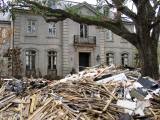
We walk beside mounds of rubble towards Tip's. Our friend accepts a paper teddy bear and holds it up to some ambient Christmas light. "Ah, Christ, what am I supposed to do about this?" Then he hands it to a passing pair of National Guardsmen.
"Let's distribute them like hand bills," he says.
It seems all those who are back are heading to Tipitina's, too. We start singing, "We three kings of Orient are . . ." When someone says, "Where is your other king?" We hand them the teddy bear named, "Senegal Breaux," and keep on our way.
"Bearing gifts we traveled so far . . ."
-------------------------------------------------------
Photo credits:
LEJ's image, Frank Parsley, Parsley Studios, Houston, Texas
LEJ's image, Frank Parsley, Parsley Studios, Houston, Texas
* * *
Copyright, 2009, Leonard Earl Johnson
Copyright, 2009, Leonard Earl Johnson
* * *

 Be Safe This Hurricane Season
Get a Frank Parsley original magnet of LEJ's fat face to scare off hurricane vermin from your refrigerator.
"It'll keep bugs out'a your ice-box, next time, sugar!"
~ L. A. Norma
Send a self - addressed & stamped envelope along with $5, $10 for both images.
Mail to:
Mail to:
Leonard Earl Johnson
Box 202
302 Jefferson St.
Lafayette, LA 70501
posted by LEJ's Louisiana | 11:50 AM
|
0 comments


