Boeuf Gras ~ The fatted bull or ox in the Rex parade. Representing Carnival's sweetly excessive celebration of death to the consumption of flesh. It is said by Louisiana journalists-emeriti and Mardi Gras overseers, Arthur Hardy and Errol Laborde to be the most photographed sight of Carnival.
 |
| Boeuf Gras ~ Rex parade ~ Mardi Gras ~ NOLa |
~ * ~ ~ * ~ ~ * ~
Captain ~ Leader of Mardi Gras
organizations called Krewes.
Carnival ~ Late Latin for "Farewell to Flesh".
Court ~ The king, queen, maids and dukes of each Mardi Gras Krewe. There is a hierarchy here culminating in Rex (Latin for King) However, no court or krewe is more important than the one you are in.
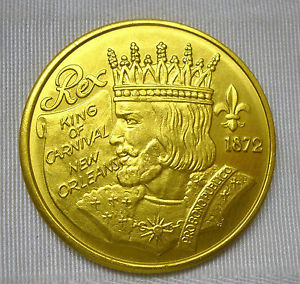
Rex ~ One of the "Big Four" oldest krewes of Louisiana Carnival. Founded in New Orleans in 1872, calling itself, The School of Design. Ponder such a name ~ with its religious, mythological and historical resonance ~ and you will see dimly into the mysteries of Carnival.
* * *
Doubloons ~ Coin-like objects bearing some Krew insignia on one side and the parade theme on the obverse. Doubloons were first introduced 1959-60 by New Orleans artist H. Alvin Sharpe. They were gold colored aluminum and first thrown by Rex in 1960. For a few years ~ even after being adopted by other krewes ~ they were generically called Rex Doubloons. Today doubloons are thrown by many krewes in various colors, themes and names.
Favor ~ This is a personalized souvenir. Given by organization members to friends. More precious than parade throws.
Invitation ~ A non-transferable printed request for attendance at a Mardi Gras ball.
King Cake ~ This is an oval bread or cake gussied up (traditionally brioche but today anything).
 |
| King Cake with Baby |
Sugared, like a "Brioche Royal"
with Mardi Gras tri colored sugars, and baked with a plastic baby doll hidden inside.
It is called "King Cake" because it commemorates the visit of the Three Kings to see the Baby Jesus, literally a Christian epiphany.
Epiphany ~ Also known as Twelfth Night, for twelfth night after Christmas. The definition of Epiphany is a first-appearance or manifestation of a divine being. In this case, the Three Kings (representing the peoples of the world) seeing for the first time the Baby Jesus, a new God (at least a new branch of an old one).
The baby doll in the King Cake is loosely seen as the Epiphanous Baby Jesus, and concurrently all temporal joys-on-Earth. In short, Something New and Good.
Overlooked by brethren of the secular press, the January 6, 2021 Insurrection at the United State's Capitol occurred on Epiphany ~ symbolic for religious minded romantics and political opportunists alike. Don't go away if you are of that persuasion, Lent is coming and your hairshirts await.
 |
Al Johnson (purple robe) and Krewe of Fans
photo credit: Mark Konikoff |
beloved song,
opens with the line:
"The Green Room is smokin' and the Plaza's burnin' down / Throw my Baby out the window, let those joints burn down..."
An act of rescue or callous disregard? Or, as we see it in Louisiana, both!
👼
👼👼
The person who finds the Baby Jesus in their cake slice is crowned "King." A king without duties other than buying the next colorful cake and giving the next King Cake Party.
Louisiana's first two Carnival parades occur in New Orleans on January 6, Epiphany. One is the Krewe of Joan of Arc, centered around her statue in the French Quarter, and honoring the liberation of Orléans, France (New Orleans "Sister City"). The other parade starts Uptown and is organized by the Phuny Phorty Phellows. Both are made up of
happily knit groups of fittingly zany swells.
The Phuny Phorty Phellows Krewe is drawn from a 1981-incarnation of 1878 revelers ~ who neither looked nor acted much like anyone today.
Originally they paraded on foot on Mardi Gras Day, behind Rex, and tossed wheat flour at each other and spectators. Today they ride the Saint Charles Streetcar in colorful costumes on Epiphany night. Without flower, but sometimes with booze and brassy music.
Around street car stops and the Car Barn are good spots to see this first-of-season show.
Krewe ~ a generic term for all Carnival organizations and clubs. Greek, Roman and Egyptian mythology are sources for half the krewe names. Some clubs are named after neighborhoods, while others are named after historical figures or places.

~ * ~ ~ * ~ ~ * ~
Krewes are chartered by cities as non-profit entities and are financed by dues or sales of krewe-emblemed merchandise to the members, who give them as favors to friends (again, more precious than the 'throws' tossed from parade floats).
Lundi Gras ~ French for Fat Monday (Mardi Gras is French for Fat Tuesday). "Fat" is a broad term for prosperity and joy, the very things being done in Carnival-excess before somber Lent takes them all away.
Lundi Gras, from 1897 to 1917 was celebrated by arrival of Rex aboard a steamboat on the Mississippi River. Revived in 1987, under the New Orleans Mayoralty of Sidney Barthelemy, a local book-learned seminarian turned Tulane trained master-of-sociology.
With mild manners and movie star looks Barthelemy revived the practice with the addition of King Zulu.
Each year since, Rex and Zulu arrive aboard separate vessels. For a few years Rex came on the streetcar. (Louisiana kings and gods are, like the King Cake Baby Jesus, very much human.)
"One River Two Boats!"
L. A. Norma wrote at the time in a letter to the old Times-Picayune daily.
Eventually Zulu and Rex
arrived at Spanish Plaza and greeted each other, "There at the foot of Poydras Street."
Comus ~ One of the oldest New Orleans krewes. First paraded in 1857 ~ four years before the Confederate Secession ~ with the parade theme: The Past, The Present, The Future.
Comus does not currently parade ~ a bitter hangover from political battles at the end of the last century with former New Orleans City Council Woman Dorothy Mae Taylor, over race restrictions in business luncheon clubs and Carnival krewes.
Comus and Rex still hold an elaborate meeting-of-the-courts ball on Mardi Gras night. But only Rex parades.
~ * ~ ~ * ~ ~ * ~
Nineteen years after The War, in 1884, the first Queen of Comus was Mildred Lee, daughter of
defeated
Confederate General Robert E. Lee, subject of the Lee Monument,
"You lose, you blues,"
a musician we know says.
💜💚💛
New Orleans is often described as a city built along a bend in The Mississippi River, and organized around Mardi Gras.
Old line Louisiana comedians tempered with cheeky Carnival spirit have been seen feigning the Sign of The Cross while saying, "Comus, Momus, Proteus and Rex," the big four of the old line New Orleans krewes. Every Louisianan alive today understands this joke.
Zulu ~ A black krewe ~ formed in New Orleans some forty years after the Civil War, and the post- War fights. |
| click image to read caption |
Battle of Liberty Place ~ a Reconstruction era battle that took place at the foot of Canal Street in front of today's Harrah's Casino. The monument was in the news lately as it, too, was targeted by Mayor Landrieu for removal.
💜💚💛
The obelisk ~ erected 1891 ~ commemorates the bloody post- Civil War battle of 14 September 1874. Part of a terrorist plot that hoped to remove the elected governor, William Pitt Kellogg. The inscription on the monument refers to the National Elections two years later ~ 1876 ~ as the moment that ended failed-Reconstruction, and united Louisiana White Supremacy with Yankee complied Jim Crow Laws. Names of whites fallen in the battle were chiseled in the stone. Names of fallen blacks, though they were sworn and uniformed policemen, were not.
Heartless tradition? Yes, and a prognostication.
The 2021 U. S. Capitol Rioters, who attacked and killed police, were blithely drawn from the malformed heirs of Abraham Lincoln's Republican party. The Capitol Police were uniformed officers of the law. As textbook clearly an example of insurrection as the dictionary has to offer.
🚬
L. A. Norma stares from inside her plume of Camel-plus smoke, and asks, "Would the King Cake Baby Jesus do such a thing?!"
Some people think both insurrections should be remembered and kept sharply in focus.
In the words of William Faulkner, "Our past is not forgotten, it is not even passed."
Two out-of-town deconstruction companies hired by Mayor Landrieu to remove New Orleans' Confederate memorials asked out of their contracts because of death threats. One, H and O Investments owner, David Mahler, had his $200,000 Lamborghini torched in the company's Baton Rouge parking lot.
Down the statues came. They are being warehoused somewhere undisclosed.
~ ~ ~
For three days in September of 1874, Louisiana Governor William Pitt Kellogg and his cronies (krewe?) took refuge in the recently built U. S. Custom House and Post Office, a handsome Union thumbprint first opened in 1856 ~ as civil war clouds gathered ~ and serving through the Nineteenth Century (including all the years of War Between the States) as the U. S. Post Office and U. S. Custom House of New Orleans.
Remember, NOLa mostly spent The War occupied, having surrendered about one year to the day after New Orleanian, Confederate General P. G. T. Beauregard fired The War's 'first shot' on Fort Sumter, in Charleston harbor (April 12, 1861). His magnificent equestrian statue has been removed from the entrance to City Park.
The first Yankee soldier reached the steps of Gallier Hall (then City Hall) on April 29, 1862. New Orleans surrendered without resistance.
"After all, Carnival was coming,"
Norma once said to two bead-laden members of the Endymion Super Krewe.
The Old Custom House still stands, at 423 Canal Street, across North Peters Street from the Yankee haberdashery, Brooks Brothers; and not more than a block away from the site of the Battle of Liberty Place. Today the crestfallen edifice is home to the Audubon Butterfly Garden and Insectarium.
"The Bug House," Norma calls it.
~ * ~ ~ * ~ ~ * ~
👇
⭐LEJ's Mardi Gras Glossary and Stories⭐
by Leonard Earl Johnson
⭐Part 2⭐
👑🍷👑
Carnival is coming,
The Swamp is getting fat.
Please put some beads
in an old man's hat.
Haven't any beads,
a half-crown will do.
Haven't got a half-crown,
Bacchus bless you.
© L.E.J.
It is a darkly shrouded background
to
Louisiana's Devil-may-care Carnival esprit.

✵💥✵
~ * ~ ~ * ~ ~ * ~
The story involves some Louisianans fitting all Louisianans into philosophical shackles as destructive to Reconstruction's reunification as the "Lost Cause War" syndrome has proven itself to be.
Unbelievable as it sounded up until recent leadership in Washington, righteous white folks in Louisiana after Lee's surrender sent a clueless delegation to meet
Ulysses S. Grant ~~~ who was just home from That War, home from Robert E. Lee's surrender to him at Appomattox, and home to be elected President of the now
re-united United States of America ~~~ to offer a freshly tinkered succession plan.
⚠
The Louisiana White League delegation arrived in Washington and proposed Grant resuscitate commerce in
The War stifled Port of New Orleans by establishing a new confederacy with its capitol located in New Orleans.
1874
Louisiana
A Post- Civil War Insurrection
Seen as a commemoration of that cause, the now removed monument at the foot of Canal Street known as the Liberty Place Obelisk is/was often targeted by Civil Rights demonstrators during events like Carnival. It was removed to a secret place of storage in 2015.
The insurrection it commemorates was drummed up by the Crescent City White League. A quirky gang of Confederate sympathizers, planters, and World traders who wanted what everyone wanted ~ at least everyone who was a World trader, planter, or Confederate sympathizer.
Hell, even President Grant wanted this, the White League reckoned, because an ill-functioning Port of New Orleans made for an ill-functioning Western Expansion of the United States.
If the Louisiana Purchase... Hell, the very War Between the States itself, were for anything ~ more than evil slavery ~ it was for control of this Western Expansion, and the newly discovered California gold!
Grant would be too, or so felt the White Leaguers.
It was, however, the establishment of another confederacy that they were advocating, though this time, they said, allied more with Washington and less with London.
London?!
Yes, London, England!
London was long in a tizzy over Spain and Portugal getting all the New World gold. When all England got was stuffy Bostonians ~~~ and later T. S. Eliot.
England built physical support for the South. Notably providing the Confederate blockade runner, CSS Alabama. The Alabama was a screw sloop-of-war built in Birkenhead, on the River Mersey (opposite Liverpool) for the purpose of running round Northern blockades of New Orleans and other ports.
She captured, sank, or burned 68 ships in 22 months before being sunk herself, in 1864 by the USS Kearsarge, off the coast of Cherbourg, France.
In 1871-72, a post War tribunal crafted the Treaty of Washington, which ordered England to pay the United States $15.5 million for damages inflicted by the Alabama. Mind you, this was 1872 dollars. During the negotiations one proposal illuminating the magnitude of the compensation, asked for secession of Canada from England and ceding it to the United States.
Yes, London supported the South and would have been on the first train to the mine fields had The War ended differently.
~ ~ ~
Back to the Louisiana White League
These masterminds pled their case before Grant, the very person recently elected to set true a course for the becalmed U. S. ship of state. They told President Grant, their Big Swamp City's Port of New Orleans would make a fine seat for this new confederacy.
Having personally just fought to defeat the old Confederacy, Grant reckoned not to take the advice of these good ole boys from Louisiana and sent them safely home to moan and mumble over their grillades-and-grits for the next two centuries.
One wonders if Grant might have considered hanging the delegation. It was, after all, treason-come-lately they were preaching.
Were they, however, civil and polite at meetings that might have taken place at the Willard Hotel? Grant is known to have favored the newly built Willard, and this was not the kind of meeting done openly in the White House. Did they drink whiskey? We figure Grant did. Did any of the Louisiana boys call on the famous pleasure houses of the victorious capitol? We figure they did. Hopefully more successfully than their audience with Grant.
Some in the delegation were from Grant Parish, founding site of the Louisiana White League (the group inciting the Liberty Place Insurrection).
Grant Parish is a "Reconstruction Parish." There were eleven such parishes created after The War, in 1869, from what had been Winn and Rapides Parishes before The War. It is located in an English section of Louisiana ~ around Alexandria and Pineville ~ and where United States Major General William Tecumseh Sherman once lived.
Here lies an even stranger story!
Sherman was from Ohio, and like Virginian, Robert E. Lee, a graduate of West Point. Lee, as you may know, was wooed to join Lincoln's Northern Army but chose to stay with The South, though he privately thought the secession unlikely to succeed.
Sherman, though a Northerner, had not yet hired on to Lincoln's army when he was appointed, in 1859, as the first president of the newly founded
at Pineville, Louisiana.
Known in its day as "The Little Seminary," it later moved to Baton Rouge and changed its name to
Louisiana State University.
💞💫💞
Yes, boys and girls, the first President of
L. S. U. was William Tecumseh Sherman!
A forerunner to Governor Jindal?
"Newcomers makin' Louisiana hay," Norma giggled.
In Creole-Carpetbagger Bobby Jindal's star crossed run against Donald Trump in 2016, Jindal screwed L. S. U., as directed by his heartless D. C. handlers and headless hometown followers.
Our Pedicab Driver interjected:
"Long as you keep payin'em, they'll keep telling you, 'you can be President, sugar!' "
We all laughed, tippled, and tossed Carnival beads to smiling tourists.
"Sherman burned Atlanta,"
our driver said,
"Bobby Jindal burned Baton Rouge!
"Both of them Republicans, too!"
Norma laughed, from inside her cloud.
👒
After The War
 |
| Courtesy of Zulu Social Aid and Pleasure Club |
Formed forty-some years after The Civil War, the black krewe, Zulu came on the scene poking heavy handed hit-and-run fun at the white krewes.
Zula would neither publish their parade route nor apply for City parade permits. They preferred 'spontaneously catching up' with Comus, Momus, Proteus, or Rex, and taunting them unannounced.
The old line krewes did not like this and had been working to stop it ever since it started.
"You can imagine their indignity at a float full of white-faced blacks coming up behind their Fatted Ox throwing coconuts!" Norma says to visitors, as she blows Carnival smoke in their faces.
🚬
🚬 🚬
Mayor Barthelemy's 1987 peace plan of Rex meeting the Zulu King at the foot of Poydras Street softened the satirical sting.
Zulu had earlier agreed to obtain parade permits and publish their route ~ today, always preceding the Rex Parade ~ and politely passing their Coconuts (now prized collectables) by hand, to avoid injuries ~ for reasons of insurance as much as respect.
~ * ~ ~ * ~ ~ * ~
 |
Rex
(Latin for King)
Members of Rex generally feel Carnival is built around their focal point. If not them alone then the four Old Line Krewes of Comus, Momus, Proteus, and Rex. For some celebrants this is true. For most it is not, but for everyone Rex is one glorious part of the spectacle.
~ ~ ~
L. A. Norma says,
"Carnival is what you make of it."
|
~ * ~ ~ * ~ ~ * ~
Throws ~ These are inexpensive souvenirs tossed from floats (since around 1871) by costumed and masked Krewe members in response to traditional calls of "Throw me something, mister!" Sometimes expressed among Acadiana French as, "Pour moi, m'sieur!"
Throws include doubloons, plastic cups and beads with and without krewe emblems.  |
| Celebrant, NOLa / photo: Carlos Detres |
Some Krewes
have uniquely
tailored throws, such as the highly sought after Zulu Coconuts;
the Krewe of Iris's Sunglasses, and the High Heeled Shoes of the Krewe of Muses.
The last two mentioned are all-female Krewes; traditionally Krewes were all male.
Ash Wednesday ~ The day after Mardi Gras, and the beginning of the forty-day Lenten fasting season.
Hangover ~ This one you may already know. It is most appropriate for Ash Wednesday.
🍷
Carnival is celebrated in most towns in Coastal Louisiana. One town most famously not celebrating Carnival is Abbeville, home of Steen's Pure Cane Syrup, and Louisiana troubadour, Bobby Charles (Walking to New Orleans, See You Later Alligator). I do not know why. When you ask locals they say it is because they host the yearly Louisiana Cattle Festival, a large effort.
It should be noted, in Louisiana one often hears it said, We lack the civic energy to do anything but Carnival!
This is a typically self-deprecating humor spoken with self- love and pride.
In truth, it is not unheard of in Louisiana to shepherd civic responsibilities and still entertain more than one festival. You can find them almost weekly in Baton Rouge, Lafayette, or New Orleans.
"Daily in Baton Rouge," Norma says, "when the legislature is in session."
The most colorful Louisiana Carnivals outside of New Orleans massive effort are the Courir de Mardi Gras (Mardi Gras Run). These are events where participants ride horseback from house to house asking for contributions to a communal gumbo pot.
Among the items given will be a live chicken or two. A grand drunken chase ensues. Hardly anyone is injured ~ if you do not count the chicken.
 |
| Courir de Mardi Gras |
~ * ~ ~ * ~ ~ * ~
This Saga of Carnival is a perfect example of a kind of Louisiana social studies practiced by those poorer souls who come to "watch Carnival."
Those in the know, know Carnival as a participatory thing. More better done than studied or written about. So take another turn round the dancefloor, Louisiana. Them smart folks are here watching us again.
Aimer la différence!
If you happen to be one of those 'smart and glum' watchers, perhaps you should consider Mobile, Alabama's Mardi Gras. Folks from Mobile held the New World's first Mardi Gras, in 1703. Mobileans brought the practice to the New Orleans colony in 1718.
Carnival in Mobile, today, is famously family/boredom friendly, and perhaps just what you are looking for.
Louisiana mounted a horse of another color and rode off in grandeur greater than Mama Mobile ever expected.
In Louisiana we party til the Purple Vestments come out on Ash Wednesday.
And a Moon Pie in New Orleans is an entirely different thing in Mobile.
💜 💚
💛
💧
🗣😷
Your comments and corrections
are welcome
click here
Comments are permitted after publication
on the first of the month.
~ ~ ~
Lagniappe du Jour
💜 💚 💛
💜💚💛
💜💚💛
💜
 |
| The Day After Mardi Gras |
💧
The Ladies Wore Red,
July 2021
Origin Story
of
The Red Women Warrior Stories
💞
 |
💜💚💛 © 2023, Leonard Earl Johnson, All Rights Reserved |
If you wish to read any month's column go to www.LEJ.world anytime. They are posted on the first of each month and polished for the next few years.
~ ~ ~
LEJ's Louisiana, Yours Truly in a Swamp Hosted by GOOGLE BLOGGER,
and historically at Les Amis de Marigny, New Orleans publication of the
It is written by Leonard Earl Johnson
of Lafayette and New Orleans, Louisiana Your comments and corrections are welcome click here Comments are permitted after publication
on the first of the month. |